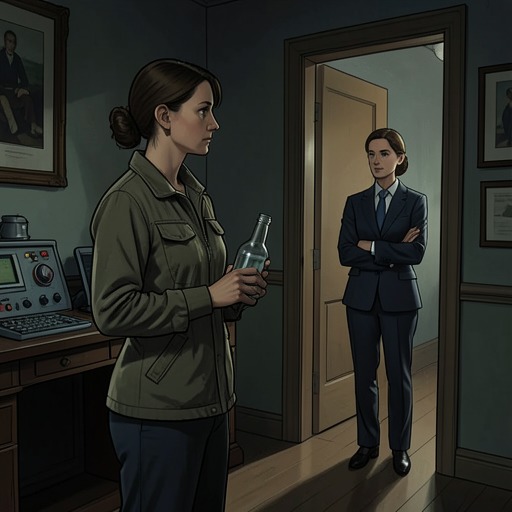
Diana Gordon
The Other Black GirlDiana Gordon is a Black novelist whose debut, Burning Heart, becomes both a touchstone for Nella Rogers and the beginning of a celebrated but compromised publishing career. The novel’s success makes Diana and her editor, Kendra Rae Phillips, public figures, while later disclosures cast doubt on Diana’s relationship with Richard Wagner and her involvement in his efforts to alter Black women’s behavior. Her story joins literary achievement to the choices and compromises made in the institutions that profit from it.
Identity and Literary Beginnings
Burning Heart, published in 1983, is Diana’s first book. Its story follows Evie, a headstrong young Black teenager who runs away from her conservative parents in a small New England town and falls in love with a Black Panther Party member. The novel becomes a lasting work for Nella: her parents give it to her for her fourteenth birthday, and she is captivated from its epigraph. During August, she reads its five hundred pages three times; she later writes about it for a summer-reading project and makes it the backbone of a senior thesis she never publishes. Nella’s attachment shows the book’s reach beyond Diana’s initial publication: it helps shape a future editor’s understanding of books by and about Black people.
The book is especially significant to Nella because both its author and editor are Black women, a combination she comes to understand as rare. In a later conversation with Richard, Nella admits that she is obsessed with Kendra Rae Phillips and Burning Heart, explaining that the novel made her fall in love with reading. Richard says he had read and admired an early draft, but stepped aside when he learned Kendra Rae wanted to work on it. He believed Kendra Rae would be the better editor for Diana. The account places Diana’s breakthrough within a collaboration, rather than presenting the book’s success as the achievement of an author acting alone.
Breakthrough and Public Success
Diana and Kendra Rae’s partnership culminates in a rapid rise to national attention. At a celebration held after the book’s first week as a number-one New York Times bestseller, Diana and Kendra Rae are treated as the evening’s central figures. Burning Heart has been on sale for only a week, yet the two Black newcomers are already being described as women of the year. Their interviews are booked for the next three months, and a major weekly magazine is considering putting them on its cover. For Diana, the success is a reversal of the modest expectations that had governed the book’s support.
Kendra Rae recalls that Richard assigned her to edit Diana’s book, gave them little money, and provided only a two-week author tour. She interprets those decisions as precautions in case the book flopped, and says she had to fight Richard throughout the process. Diana answers that the book has been made and that they are present at the celebration; she urges Kendra Rae to treat the earlier refusals as less important than the one yes that brought the book into the world. Her response does not erase the unequal resources or doubts Kendra Rae describes. Instead, the scene holds triumph and grievance together: the bestseller is real, but its success does not make the process that produced it fair.
Diana’s first Wagner check gives that breakthrough a private, comic measure. She says she laid it on the kitchen table and stared at it for about forty minutes, perhaps an hour. When Elroy K. Simpson came home and reached for it, she barked at him, although she had never done so before. Recounting the incident makes both women howl with laughter. The check is more than a financial detail: it marks the moment when an achievement that had been abstract became something Diana could hold, while her startled reaction makes visible just how unfamiliar and overwhelming the reward felt.
Friendships and Shared History
Diana’s relationships reach back well before her literary fame. At the celebration, she recognizes Kendra Rae’s exhaustion with the guests and links arms with her, trying to draw her attention toward the elaborate surroundings. Kendra Rae is unimpressed by the expensive meal and the Financial District venue, which she associates with the history of the slave market. She is also still angry about the skepticism that greeted Burning Heart. Their easy physical closeness and laughter are signs of intimacy, but the conversation reveals that affection does not prevent disagreement about what the book’s success should mean or how much weight to give the obstacles behind it.
Their friendship is also rooted in a shared youth. Laughing over the first check brings back their high-school preparations for roller-skating at the Eight Skate in Newark with their friends. Diana remembers red juice, liquor Imani had managed to sneak from her parents’ stash, and the girls singing while her hair was pressed. Kendra Rae was usually the one pressing it, because she knew to stop dancing while holding the hot iron. The recollection makes their later professional partnership feel continuous with an earlier world of friendship, care, and shared cultural life, rather than a relationship created by the bestseller alone.
A photograph in Richard’s office offers a more ambiguous image of that history. It shows a younger Richard with one hand on Diana’s shoulder and the other on a second Black woman; Diana, in a bright white dress, resembles the successful author Nella later sees in interviews. The other woman leans slightly away, holding a martini and looking directly at the camera without the same apparent smile. The contrast does not by itself establish what happened between the people in the photograph, but it gives Nella a visual record of Diana’s earlier proximity to Richard and to another Black woman whose expression resists the picture’s celebratory appearance.
Richard Wagner and Kendra Rae’s Accusation
Years later, Kendra Rae tells Nella that she believes Diana was changed by Richard. Kendra Rae says she and Diana had been friends since they were younger than the women listening to her; on the night she left, she heard Diana discussing something Imani had said on the phone. Kendra Rae connects that conversation to Richard, whom Diana was speaking with, and to Diana’s apparent effort to do the same thing to her. She also says Diana would no longer be seen with her in public after Kendra Rae spoke out. Lynn Johnson adds that Richard was Kendra Rae’s boss and is now Nella’s, and that his frequent presence at Diana’s events and appearances in her acknowledgments had made the connection noticeable.
These disclosures are presented as Kendra Rae’s explanation, not as an independently confirmed account of Diana’s actions. Her suspicion is nevertheless sharpened by a later account in Diana’s own perspective. Diana remembers intending to help Kendra Rae relax, describing the plan to herself as a temporary adjustment that might let them continue toward greater influence and perhaps create their own imprint or Black publishing house. She says she felt she owed Kendra Rae that possibility. In the same recollection, Diana describes Richard asking her to intervene in cases involving Black workers who had criticized white employers. She refused two requests, then learned that both workers had been fired and left unemployed. When the next request came, she reasoned that although she had not been able to save Kendra Rae, she might save others. The passage establishes Diana’s participation in Richard’s requests and her stated rationale; it does not resolve the full extent of what she did to Kendra Rae.
Narrative Role and Significance
Diana’s characterization is built through shifts in perspective and time. Nella first encounters her through a book that helped form Nella as a reader; the celebratory memory of Burning Heart then presents Diana as a witty, successful collaborator and an old friend. The later account of Kendra Rae’s departure and Diana’s own recollection of Richard’s requests complicate that public image. Together, the scenes resist a simple choice between literary heroine and villain: Diana’s loyalty to Kendra Rae, her desire for collective advancement, and her willingness to participate in Richard’s scheme coexist uneasily.
That contradiction is central to Diana’s significance in the novel. Burning Heart represents a rare success for Black women in publishing and has genuine consequences for readers such as Nella. Yet the success does not protect its creators from underinvestment, institutional control, or pressure to manage other Black women. Diana’s memories of the check, the old friends, and the shared labor around her hair preserve the intimacy and material texture of a life beyond celebrity; the later allegations make that history newly difficult to read. Her arc asks what happens when the promise of building power together becomes entangled with a system that asks its beneficiaries to help discipline others.